Human Orbital Spaceflights

International Flight No. 312Soyuz MS-09AltaiRussia |
 |
 |
 |
||
Launch, orbit and landing data
walkout photo |
 |
|||||||||||||||||||||||
alternative crew photo |
original crew photo |
|||||||||||||||||||||||
alternative crew photo |
original crew photo |
|||||||||||||||||||||||
alternative crew photo |
alternative crew photo |
|||||||||||||||||||||||
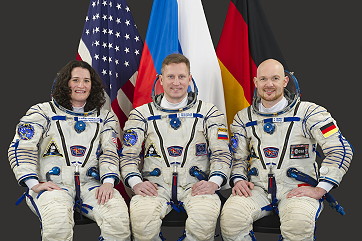
Crew
| No. | Surname | Given names | Position | Flight No. | Duration | Orbits | |
| 1 |  |
Prokopyev | Sergei Valerievich | Commander | 1 | 196d 17h 50m 09s | 3152 |
| 2 |  |
Gerst | Alexander | Flight Engineer | 2 | 196d 17h 50m 09s | 3152 |
| 3 |  |
Auñón-Chancellor | Serena Maria | Flight Engineer | 1 | 196d 17h 50m 09s | 3152 |
Crew seating arrangement
|
 |
|
||||||||||||||||
Backup Crew
 |

alternative crew photoalternative crew photo |
||||||||||||||||||||

Hardware
| Launch vehicle: | Soyuz-FG (No. 1M139S U15000-064) |
| Spacecraft: | Soyuz MS-09 (MS No. 739) |
Flight
|
Launch from the Baikonur Cosmodrome. ISS Expedition
56 /
57. Landing 153 km
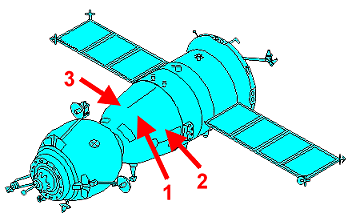
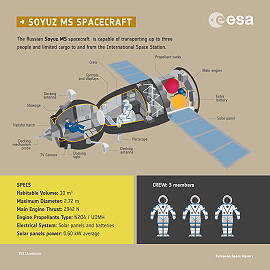
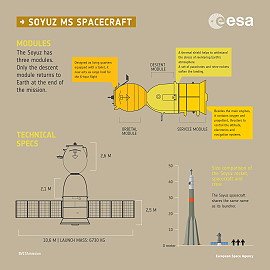
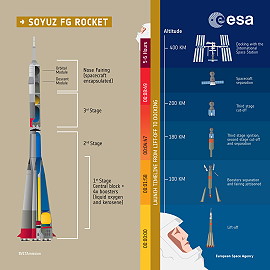
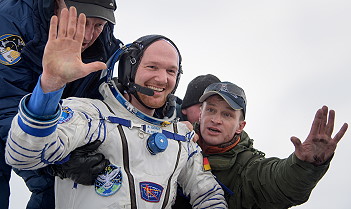
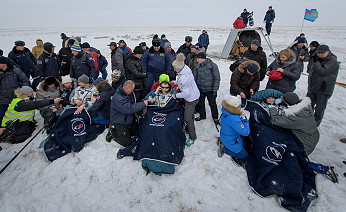
southeast of Dzheskasgan. Originally NASA Astronaut Jeannette Epps was assigned as Flight Engineer for Expeditions 56 and 57, becoming the first African American space station crew member and the 15th African American to fly in space, but on January 16, 2018, NASA announced that Epps had been replaced by her backup Serena Auñón-Chancellor with no announced explanation as to why. But she was considered for assignment to future missions. Following a two-day solo flight Soyuz MS-09 docked to ISS on June 08, 2018. Sergei Prokopyev, Alexander Gerst and Serena Auñón-Chancellor became the ISS Expedition 56 (together with ISS Expedition 55 crew members Oleg Artemyev, Andrew Feustel and Richard Arnold). With the arrival Expedition 56 became a six-person-crew. The Soyuz spacecraft is composed of three elements attached end-to-end - the Orbital Module, the Descent Module and the Instrumentation/Propulsion Module. The crew occupied the central element, the Descent Module. The other two modules are jettisoned prior to re-entry. They burn up in the atmosphere, so only the Descent Module returned to Earth. The deorbit burn lasted 265 seconds. Having shed two-thirds of its mass, the Soyuz reached Entry Interface - a point 400,000 feet (121.9 kilometers) above the Earth, where friction due to the thickening atmosphere began to heat its outer surfaces. With only 23 minutes left before it lands on the grassy plains of central Asia, attention in the module turned to slowing its rate of descent. Eight minutes later, the spacecraft was streaking through the sky at a rate of 755 feet (230 meters) per second. Before it touched down, its speed slowed to only 5 feet (1.5 meter) per second, and it lands at an even lower speed than that. Several onboard features ensure that the vehicle and crew land safely and in relative comfort. Four parachutes, deployed 15 minutes before landing, dramatically slowed the vehicle's rate of descent. Two pilot parachutes were the first to be released, and a drogue chute attached to the second one followed immediately after. The drogue, measuring 24 square meters (258 square feet) in area, slowed the rate of descent from 755 feet (230 meters) per second to 262 feet (80 meters) per second. The main parachute was the last to emerge. It is the largest chute, with a surface area of 10,764 square feet (1,000 square meters). Its harnesses shifted the vehicle's attitude to a 30-degree angle relative to the ground, dissipating heat, and then shifted it again to a straight vertical descent prior to landing. The main chute slowed the Soyuz to a descent rate of only 24 feet (7.3 meters) per second, which is still too fast for a comfortable landing. One second before touchdown, two sets of three small engines on the bottom of the vehicle fired, slowing the vehicle to soften the landing. |
Graphics / Photos
 |
 |
 |
 |
|
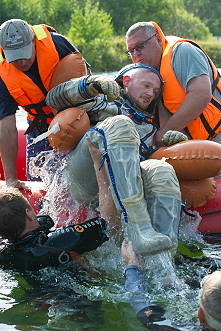
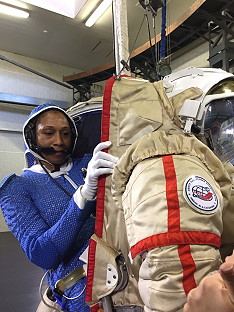
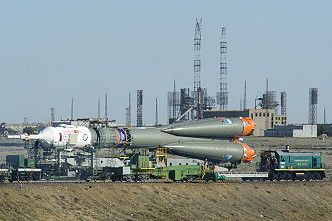
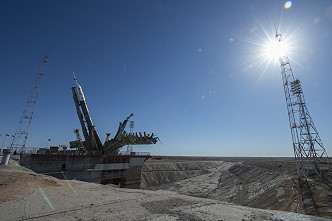
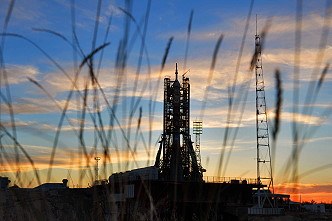
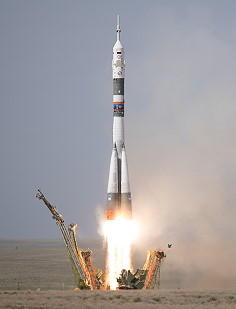
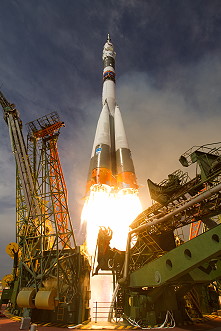
source of the training, rollout, launch and landing photos is Roscosmos |
|
 |
 |
 |
 |
 |
 |
 |
 |
 |
 |
 |
 |
 |
| © |  |
Last update on July 22, 2025.  |
 |